Jack and Trixie’s unresolved romantic-sexual relationship
It Must Be Love: A Mustang Prairie RomanceJack and Trixie’s unresolved romantic-sexual relationship is the central push-and-pull between desire and emotional risk. What begins in flirtation becomes a series of kisses, hookups, and increasingly intimate disclosures, but the connection remains unstable because Jack is still shaped by his marriage to Marissa Thorpe and Trixie will not accept a place at the edge of a life governed by grief. The relationship’s decisive movement is therefore not simply from attraction to sex, but from an arrangement both characters try to limit toward an admission that their intimacy has acquired the weight of love.
Attraction and Early Resistance
Jack’s attraction is evident before he is willing to name it. When Dylan identifies Trixie as the woman occupying his thoughts, Jack recognizes that he is drawn to her red hair, curves, retro clothing, and sensual presence, even as he tries to disguise uncertainty with denial. His earlier hostility toward her makes the attraction more conflicted: in the shop, he sees her teaching Abby Thorpe to make a shrug and reacts with furious moral outrage, calling the back room a “dungeon of perversity.” The accusation exposes less about Trixie’s conduct than about Jack’s inability to remain composed around a woman whose sexuality and independence unsettle him.
Trixie’s position is equally divided. She has carried feelings for Jack for years, yet after his anger and rejection she tells Sadie that she is finished crushing on him, adding the qualification that one day she might mean it. Her determination to stop pursuing him becomes an early form of self-protection. The relationship is thus marked from the outset by asymmetry and concealment: Trixie knows the danger of wanting him, while Jack experiences the desire as a disruptive force he has not yet integrated into his understanding of himself.
Physical Intimacy and the Friends-with-Benefits Pattern
The first kiss converts antagonism into unmistakable mutual desire. In Trixie’s store, Jack corners her near the cash register, asks whether she has eaten, and then kisses her with a gentleness that quickly becomes consuming. Trixie responds fully, and the intensity of the encounter makes clear that neither character can treat the attraction as casual in the bodily sense, even if both might later attempt to describe it that way. Their physical reaction becomes a language that precedes any agreed definition of the relationship.
Jack ignores his friends’ warnings that a casual involvement with Trixie would be dangerous and stops at her house to ask her out. Their second major kiss follows a day spent helping her transport and organize supplies. The enclosed intimacy of the car and house makes proximity addictive for him, while Trixie’s response confirms that the attraction is reciprocal. Yet when she pulls away and says they cannot continue, Jack is surprised because he has interpreted the intensity of the kiss as an invitation to further sexual intimacy. Her refusal introduces the central problem: desire is shared, but its meaning is not.
Their later encounter becomes explicitly negotiated through Trixie’s lingerie business. When she asks for his terms, Jack requests that she model her new line for him, placing her professional identity and erotic self-presentation inside their private exchange. Trixie retains agency over the escalation: after considering his request, she pulls him into a hungry kiss, and the encounter moves from flirtatious bargaining to sexual intimacy in her kitchen. The scene joins her entrepreneurial work to the relationship’s erotic charge, but it also reinforces the danger of allowing physical chemistry to stand in for emotional agreement.
After they sleep together, Jack tells Trixie that the night was “great, fantastic in fact,” but that he cannot make promises because his life is already full and chaotic. His qualification changes the meaning of the encounter for her. Trixie later tells Sadie that they have hooked up a few times, that Jack is still in love with his wife, and that he does not want anything serious. She acknowledges that the sex was exceptionally good, but insists that it is over and resolves not to chase a man who does not want to be caught. Her language turns restraint into a principle: she may desire Jack, but she will not surrender the option of a future to a relationship that has already announced its limits.
Emotional Barriers and the Shadow of Marissa Thorpe
The limits Trixie encounters are not merely Jack’s reluctance to label their intimacy; they are the consequence of a grief he has never fully explained. He tells her that he and Marissa Thorpe had been close to divorce when she died, after an argument in which she accused him of needing to take care of the children. Marissa then suffered an aneurysm while driving and died before her car struck a tree, while the town continued to believe a simpler story about a fortunate marriage cut short. Jack’s silence has therefore protected both his reputation and his paralysis. He assumes that because he once loved Marissa, and because their marriage ended in death rather than an ordinary separation, he has no right or capacity to begin again. Trixie understands that entering his life would mean competing not only with a memory but with an idealized public version of that marriage. His mother tells him that Trixie may need to know the truth because it is difficult to compete with a ghost, making explicit the emotional structure that has kept the relationship suspended. Jack’s attraction to Trixie is real, but his fear of repeating the past turns that attraction into a cycle of approach, retreat, and defensive ambiguity.
Public Performance and Private Stakes
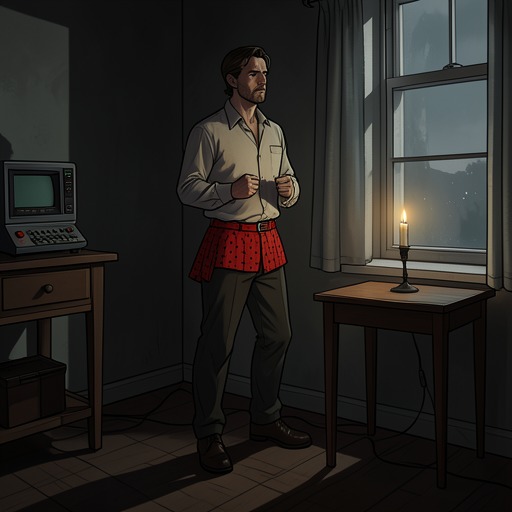
The relationship’s uncertainty is repeatedly staged through public encounters in which attraction must be disguised as banter or hostility. At a community gathering, Jack’s jealousy surfaces when Trixie steadies herself against Ty, while Ty openly teases her about her lingerie work; Jack’s irritation exposes how possessive his feelings have become even before he can articulate them. At the Halloween party, Trixie’s costume and playful movement intensify his attention, but the same spectacle also makes their intimacy vulnerable to other people’s eyes. Their connection therefore exists in two registers at once: publicly, it is filtered through jokes, friends, and sexualized clothing; privately, it is governed by touches, kisses, and the fear that either character will ask for more than the other can give. Trixie’s clothing is not merely decoration within this pattern. Her white tank, red bra, black leather pants, boots, and jacket mark the confidence with which she enters dinner with Jack, while her work as the creator of Sexy Separates by Trixie gives her erotic presentation a professional and self-directed dimension. Jack is drawn to that combination of visibility and control, yet his desire does not dissolve the emotional boundary she has established.
From Defensive Distance to Emotional Recognition
The relationship’s turning point arrives when avoidance can no longer contain what the intimacy has become. At the launch of Sexy Separates by Trixie, Trixie tries to treat Jack’s congratulations as an ordinary courtesy, even though his voice has occupied her dreams and she has spent much of her life loving him. She brushes past him because she believes he does not understand that she now knows the truth about his emotional limitations. Her restraint is not a disappearance of feeling; it is an attempt to preserve dignity after concluding that he remains attached to Marissa Thorpe and cannot offer a serious future.
Jack’s understanding changes through absence. At his art opening, he searches for Trixie throughout the night and mistakes her nonattendance for the same lack of support he associated with Marissa. Dylan then reveals that Jack himself forgot to invite her. The realization unsettles the story Jack has been telling himself: his disappointment was not evidence that Trixie had failed him, but proof that her presence had become necessary to his sense of success. He stands before one painting unable to enjoy the evening because he is trying to deny that he loves her. The omission therefore becomes an accidental test of emotional priority, exposing that Trixie has moved beyond the role of an attractive distraction.
When Jack finally explains himself, he distinguishes his former marriage from the relationship developing with Trixie. He admits that he had believed the only love he knew was the immature, painful kind he experienced with Marissa, and that this assumption prevented him from recognizing a different form of attachment. With Trixie, love feels comfortable and thrilling, fun and sexual rather than governed by resentment and public appearances. His declaration, “Yes Trixie, I love you,” does not erase the earlier evasions, the casual arrangement, or the wound left by Marissa’s death; it names what those evasions had been protecting. Trixie remains skeptical, asking how he can be certain, while Jack identifies his failure not as an absence of feeling but as the slowness with which he understood it.
This recognition alters the relationship’s governing conflict. Trixie had demanded the option of seriousness because she would not waste time on intimacy with no possible future, while Jack had treated emotional limitation as a safeguard against repeating his marriage. His confession begins to replace that defensive arrangement with emotional honesty. The relationship’s significance lies in this change of terms: physical desire first forces the pair into proximity, but the possibility of a lasting bond emerges only when Jack accepts that grief cannot serve as a permanent refusal of love and when Trixie’s insistence on self-respect makes mutual commitment a condition rather than a reward for continued waiting.
From Defensive Distance to Emotional Recognition
The relationship’s turning point arrives when avoidance can no longer contain what the intimacy has become. At the launch of Sexy Separates by Trixie, Trixie tries to treat Jack’s congratulations as an ordinary courtesy, even though his voice has occupied her dreams and she has spent much of her life loving him. She brushes past him because she believes he does not understand that she now knows the truth about his emotional limitations. Her restraint is not a disappearance of feeling; it is an attempt to preserve dignity after concluding that he remains attached to Marissa Thorpe and cannot offer a serious future.
Jack’s understanding changes through absence. At his art opening, he searches for Trixie throughout the night and mistakes her nonattendance for the same lack of support he associated with Marissa. Dylan then reveals that Jack himself forgot to invite her. The realization unsettles the story Jack has been telling himself: his disappointment was not evidence that Trixie had failed him, but proof that her presence had become necessary to his sense of success. He stands before one painting unable to enjoy the evening because he is trying to deny that he loves her. The omission therefore becomes an accidental test of emotional priority, exposing that Trixie has moved beyond the role of an attractive distraction.
When Jack finally explains himself, he distinguishes his former marriage from the relationship developing with Trixie. He admits that he had believed the only love he knew was the immature, painful kind he experienced with Marissa, and that this assumption prevented him from recognizing a different form of attachment. With Trixie, love feels comfortable and thrilling, fun and sexual rather than governed by resentment and public appearances. His declaration, "Yes Trixie, I love you," does not erase the earlier evasions, the casual arrangement, or the wound left by Marissa’s death; it names what those evasions had been protecting. Trixie remains skeptical, asking how he can be certain, while Jack identifies his failure not as an absence of feeling but as the slowness with which he understood it.
This recognition alters the relationship’s governing conflict. Trixie had demanded the option of seriousness because she would not waste time on intimacy with no possible future, while Jack had treated emotional limitation as a safeguard against repeating his marriage. His confession begins to replace that defensive arrangement with emotional honesty. The relationship’s significance lies in this change of terms: physical desire first forces the pair into proximity, but the possibility of a lasting bond emerges only when Jack accepts that grief cannot serve as a permanent refusal of love and when Trixie’s insistence on self-respect makes mutual commitment a condition rather than a reward for continued waiting.
From Defensive Distance to Emotional Recognition
The relationship’s decisive shift occurs when avoidance can no longer contain what intimacy has become. At the launch of Sexy Separates by Trixie, Trixie treats Jack’s congratulations as a courtesy even though his voice has occupied her dreams and she has loved him for nearly all her life. She tries to pass him because she now believes he cannot offer a serious future, but her restraint conceals continuing attachment rather than ending it.
Jack’s understanding changes through absence. At his art opening, he searches for Trixie and mistakes her nonattendance for the kind of refusal to support him that he associated with Marissa Thorpe. Dylan then reveals that Jack himself forgot to invite her. The discovery turns his disappointment inward: Trixie’s absence hurts because her presence has become necessary to his sense of success. Standing before one painting, he cannot enjoy the evening while trying to deny that he loves her. His omission therefore becomes an accidental measure of emotional priority, proving that she has moved beyond the role of an attractive distraction.
When Jack explains himself, he distinguishes his former marriage from the relationship developing with Trixie. He acknowledges that he had mistaken the immature, painful love he knew with Marissa for the only possible form of love, and that this assumption prevented him from recognizing an attachment that is comfortable, thrilling, fun, and sexual. His declaration, "Yes Trixie, I love you," does not erase his earlier evasions, the casual arrangement, or the wound left by Marissa’s death; it gives those evasions a name. Trixie remains skeptical and asks how he can be certain, while Jack identifies his failure as the slowness with which he understood what he felt.
This recognition changes the relationship’s terms. Trixie has insisted on the option of seriousness because she will not waste time on intimacy with no possible future, while Jack has treated emotional limitation as protection against repeating his marriage. His confession begins to replace that defensive arrangement with emotional honesty. Physical desire first forces the pair into proximity, but a lasting bond becomes possible only when Jack stops allowing grief to function as a permanent refusal of love and when Trixie’s self-respect makes mutual commitment a condition of continuing intimacy rather than a reward for waiting indefinitely.